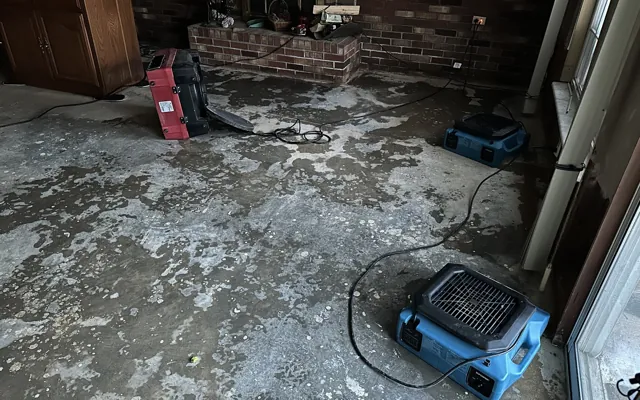
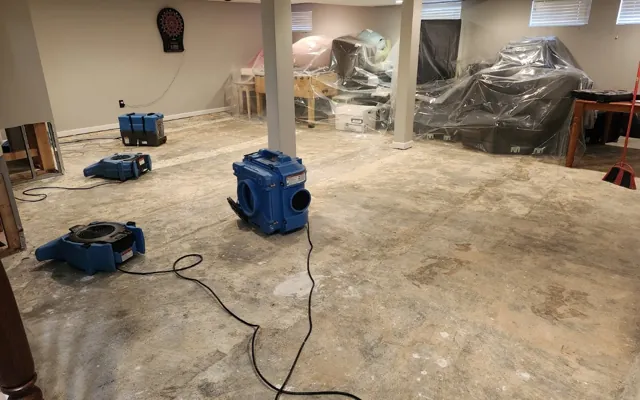
When a Raleigh, NC storm or flood hits, local crews arrive fast to extract water, muck out debris, and dry the structure to IICRC-standard targets, aiming to prevent deeper damage.

Technicians start by removing all standing water from affected rooms and low points. Fast pumping in Raleigh's multi-level homes helps prevent water from wicking up walls and causing more extensive structural damage.
The crew clears out mud, storm debris, and any contaminated porous materials that cannot be saved. All surfaces touched by flood water are then thoroughly cleaned and treated with antimicrobial solutions.
Using industrial air movers and dehumidifiers, the team dries the structure to meet IICRC-standard moisture targets. They document the process with readings and photos for the homeowner and insurance.

Storm and flood cleanup in Raleigh typically runs from about $2,000 to $8,000, depending on how much water got in, how far it spread, how much muck-out and material removal is needed, and whether the water was contaminated. A contained event sits low, while widespread flooding with Category 3 water sits higher. Coverage depends on the policy, since surface flooding often needs separate flood insurance, and crews document everything.
In Raleigh's older neighborhoods, many pre-1980 homes with cast-iron drainage sit beneath mature trees and aging roofs. This combination creates the metro's highest volume of burst-pipe and storm-flood incidents, where water damage can spread quickly through multiple levels of a home. Raleigh's mature trees near older plumbing, combined with the Piedmont's humid subtropical climate and occasional hard freezes, make west-side homes prone to pipe bursts and storm-water intrusion, especially where drainage is overtaxed. From Raleigh, crews also cover nearby New Hill, Carpenter, West Raleigh, Green Level, Holly Springs, Apex. See every neighborhood and town on the full service area page.
See all areas servedEvery loss is photographed, measured, and logged from the first visit, so the paperwork holds up with your insurance carrier.
Technicians follow recognized IICRC drying standards and prove the work with daily moisture readings, not guesswork.
Emergency dispatch any hour of the day or night, with a real crew on the way, not a callback in the morning.
A real crew dispatched any hour, not a callback in the morning.
Trained technicians following recognized IICRC drying standards.
Truck-mounted, portable, and submersible for any size loss.
The loss is documented and billed to the carrier directly.
Coverage depends entirely on the specific policy. Standard policies often cover sudden water damage from storms, like a roof leak, but surface flooding typically requires separate flood insurance. Local crews document everything thoroughly to support any claim.
Drying time depends on the water's spread, contamination level, and the home's materials. For a contained area, it may take a few days. For widespread flooding in a basement or crawlspace, it often takes three to five days of continuous drying to reach IICRC standards.
Crews are on call 24 hours a day and can be on the way to Raleigh within the hour.
Call (984) 331-5759