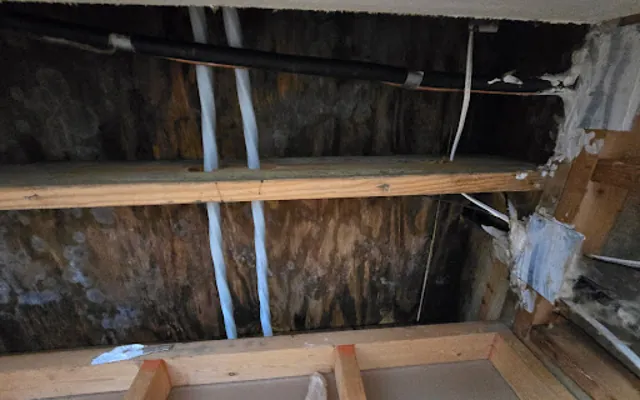
Storm winds and driving rain work flashing and shingles loose, and the water shows up as a stained, sagging ceiling. Crews across Cary dry the attic and structure and stop the spread, on site in about an hour.

Crews find the roof entry point and follow the water down through the attic and into ceilings and walls with meters and thermal imaging.
The roof is tarped or protected where needed to stop more water, and standing water in the attic and on ceilings is extracted.
Wet insulation is removed where needed and air movers and dehumidifiers dry the framing, decking, ceilings, and walls to an IICRC-standard target.
Readings confirm the structure is dry before repair, and the source and drying are documented for the insurance claim.

While help is on the way, these first steps, done only where it is safe, limit the damage and protect the insurance claim.
Shut the supply off at the source, or close the home's main valve if the source is not obvious. Stopping the flow limits the damage more than anything else.
Switch off electricity to the affected area, but only if the breaker can be reached without standing in or touching the water.
Get a crew dispatched right away. The sooner extraction and drying begin, the more flooring, drywall, and belongings can be saved.
Take photos and a short video of the water and the affected rooms before anything is moved, so the insurance claim starts strong.
Roof leak water damage cleanup in Cary typically runs from about $1,200 to $5,000, depending on how much water got in, how much attic insulation, ceiling, and wall soaked, and how much drywall has to be dried or replaced. A small, caught-early leak sits low, while storm-driven saturation across attic and ceilings sits higher. Sudden storm losses are commonly covered, though the roof repair itself is scoped separately.
Crews reach Cary and Wake County fast, from Downtown Cary, Method, and West Raleigh to nearby Apex, Morrisville, Holly Springs, Garner, and Fuquay-Varina. See the full list on the areas served across Cary page.
See all areas servedEvery loss is photographed, measured, and logged from the first visit, so the paperwork holds up with your insurance carrier.
Technicians follow recognized IICRC drying standards and prove the work with daily moisture readings, not guesswork.
Emergency dispatch any hour of the day or night, with a real crew on the way, not a callback in the morning.
A real crew dispatched any hour, not a callback in the morning.
Trained technicians following recognized IICRC drying standards.
Truck-mounted, portable, and submersible for any size loss.
The loss is documented and billed to the carrier directly.
Water that gets through the roof runs along the decking and framing and drops at the lowest or weakest point, which is often a ceiling seam or a light fixture a room or two from where it entered. That is why crews trace the water rather than assuming the leak is directly above the stain.
Crews handle the water damage, dry the structure, and can tarp or protect the roof to stop more water. The permanent roof repair itself is done by a roofer. Stopping the intrusion and drying the attic and ceilings is what limits the interior damage.
Quickly. Even a small leak keeps soaking the attic and ceiling with every storm, and the Piedmont's humidity keeps the cavity damp between rains. The longer it goes, the more decking and framing are at risk, so early drying protects the structure.
Sudden storm-driven interior water damage is commonly covered, while damage from a roof that was worn out and neglected may be limited. Crews document the source and the drying so the interior claim is well supported.
Cary crews are on call 24 hours a day, local and fast, and can be on the way within the hour.
Call (984) 331-5759