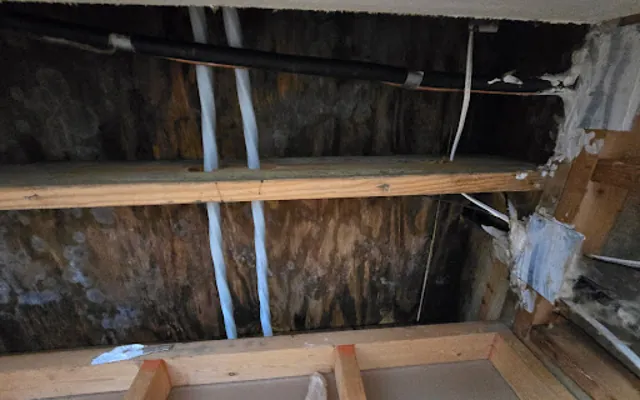
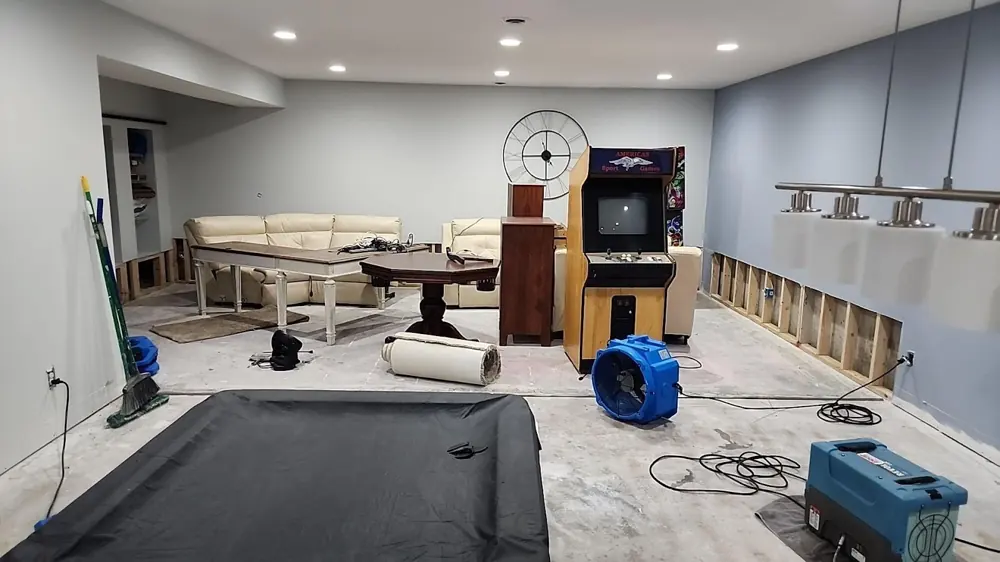
Ice dams are uncommon in the Piedmont, but a rare snow or hard ice storm can back water up under the shingles. When it does, crews across Cary dry the ceilings and walls fast, on site in about an hour.

Crews find where the backed-up water entered the roof and attic and map how far it traveled into ceilings and walls with meters and thermal imaging.
Standing water in the attic is extracted and any bulging ceiling below is relieved and drained safely so it does not fall.
Wet insulation is removed where needed and air movers and dehumidifiers dry the framing, ceilings, and walls to an IICRC-standard target.
Readings confirm the structure is dry before repair, and the source and drying are documented for the insurance claim.

While help is on the way, these first steps, done only where it is safe, limit the damage and protect the insurance claim.
Shut the supply off at the source, or close the home's main valve if the source is not obvious. Stopping the flow limits the damage more than anything else.
Switch off electricity to the affected area, but only if the breaker can be reached without standing in or touching the water.
Get a crew dispatched right away. The sooner extraction and drying begin, the more flooring, drywall, and belongings can be saved.
Take photos and a short video of the water and the affected rooms before anything is moved, so the insurance claim starts strong.
Ice dam water damage cleanup in Cary typically runs from about $1,200 to $5,000, depending on how much water backed into the attic and structure, how many ceilings and walls soaked, and how much insulation and drywall has to be dried or replaced. A small, caught-early leak sits low, while widespread attic and ceiling saturation sits higher. Sudden storm-driven losses are commonly covered.
Crews reach Cary and Wake County fast, from Downtown Cary, Method, and West Raleigh to nearby Apex, Morrisville, Holly Springs, Garner, and Fuquay-Varina. See the full list on the areas served across Cary page.
See all areas servedEvery loss is photographed, measured, and logged from the first visit, so the paperwork holds up with your insurance carrier.
Technicians follow recognized IICRC drying standards and prove the work with daily moisture readings, not guesswork.
Emergency dispatch any hour of the day or night, with a real crew on the way, not a callback in the morning.
A real crew dispatched any hour, not a callback in the morning.
Trained technicians following recognized IICRC drying standards.
Truck-mounted, portable, and submersible for any size loss.
The loss is documented and billed to the carrier directly.
Rarely. Ice dams need accumulated snow and a run of cold, which the Piedmont does not get most winters. But the occasional snow or ice storm that lingers on a roof can back water up under the shingles, especially on older or under-insulated homes, so it does happen from time to time.
Water from an ice dam enters high at the roofline and travels down through the attic and into ceilings and walls before it surfaces. That path takes time, so a stain or a wet wall can appear days after the ice formed, which is why the source is traced rather than assumed.
Good attic insulation and ventilation keep the roof deck cold and even, which reduces the melt-and-refreeze cycle that forms dams. After a loss, crews often note where insulation was thin so it can be improved before the next winter storm.
Sudden interior water damage from an ice dam is commonly covered under homeowner policies, though coverage varies. Crews document the source, the water path, and the drying so the adjuster has clear support for the claim.
Cary crews are on call 24 hours a day, local and fast, and can be on the way within the hour.
Call (984) 331-5759